
AROUND ANNAPURNA TREKKING
Annapurna Base Camp
0/5
0% of guests recommend
Location
Nepal
Overview
“A great wonderful adventure around both sides of the massive Annapurna Mountains Range listed as the world’s best adventure destinations by Lonely Planet and other guide/travel books. Walking into high and scenic Manang valley towards Mustang area via Thorang-la pass. Exceptional views of peaks on daily walks to windswept Manang Valley and its villages. Explore the beautiful culture and customs of the Buddhist religion around traditional Manang villages. Glorious panorama with a stunning sunrise over the chain of mountains from scenic Poon Hill. Walk into a beautiful hill forest covered with rhododendron-oak and pine trees. Daily views of Annapurna Himalaya with close views of Dhaulagiri and Manaslu peaks from low warm paddy fields to cooler alpine hills and towards the arctic zone of ice and glaciers.”
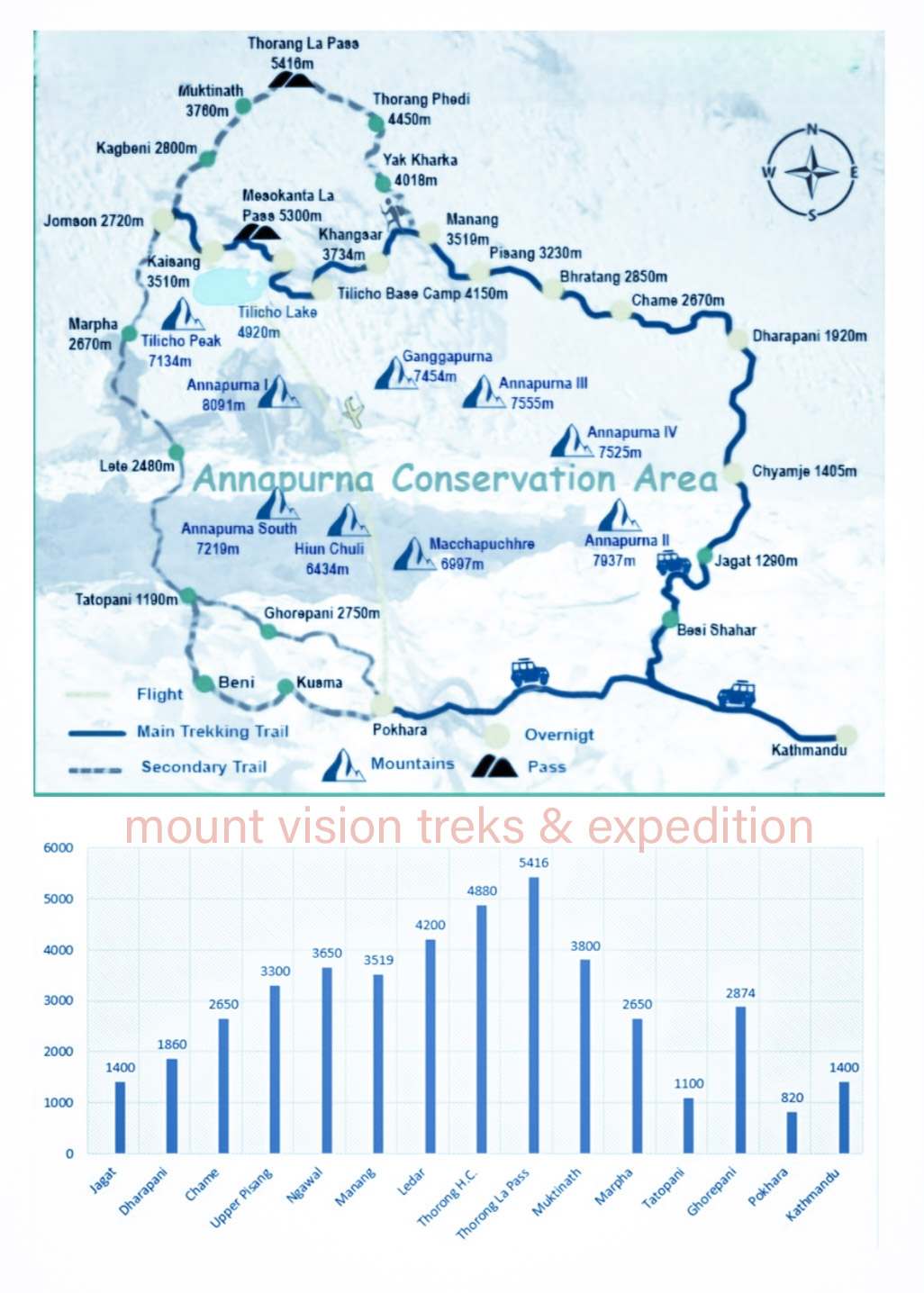
MAJOR HIGHLIGHTS OF AROUND ANNAPURNA TREKKING
Thorong La Pass (5,416 m)
One of the highest trekking passes in the world, offering breathtaking panoramic views of Annapurna, Dhaulagiri, and other Himalayan peaks.
Diverse Landscapes
Journey through lush subtropical forests, alpine meadows, and arid high-altitude deserts, showcasing Nepal’s incredible geographic diversity.
Scenic Villages and Local Culture
Experience unique Himalayan culture in villages like Manang, Pisang, Chame, and Kagbeni, with rich traditions of Gurung, Thakali, and Tibetan-influenced communities.
Tilicho Lake (4,919 m)
An optional detour to visit one of the highest lakes in the world, surrounded by snow-capped peaks.
Natural Hot Springs (Tatopani)
Relax in the natural hot springs at Tatopani, rejuvenating after long days of trekking.
Annapurna and Dhaulagiri Range Views
Spectacular close-up views of Annapurna I (8,091 m), Dhaulagiri (8,167 m), and other iconic peaks.
Kaligandaki Gorge
Trek through the world’s deepest gorge, located between Annapurna and Dhaulagiri ranges.
Muktinath Temple
A sacred pilgrimage site for Hindus and Buddhists, featuring a temple and 108 water spouts believed to cleanse sins.
Flora and Fauna of Annapurna Conservation Area
Spot rare wildlife like Himalayan Thar, Snow Leopards (rarely), and exotic birds, and trek through rhododendron forests.
Apple Orchards in Marpha
Enjoy fresh apples and apple-based products like cider and pies in the charming village of Marpha.
Buddhist Monasteries
Visit ancient monasteries like Braga Monastery, showcasing Tibetan Buddhist traditions and architecture.
Suspension Bridges and Waterfalls
Cross thrilling suspension bridges over raging rivers and encounter stunning waterfalls en route.
High-Altitude Tea Houses
Experience authentic hospitality and stay in tea houses with spectacular mountain backdrops.
Accessible for All Levels
A mix of moderate to challenging routes suitable for both beginners (with preparation) and seasoned trekkers.
Spectacular Sunrises and Sunsets
Witness awe-inspiring views from various viewpoints, such as Poon Hill, if included in the itinerary.
Cultural Festivals (Seasonal)
Depending on the time of the trek, you might witness local festivals like Lhosar or Dashain.
This trek offers an unforgettable blend of adventure, culture, and natural beauty, making it one of the most iconic trekking routes in the world.
|
Mode of Trekking: |
Hotels and in lodge on walks. |
|
Trek Grade: |
Moderate and Adventurous. |
|
Area of Trek: |
Nepal North Mid-West within Annapurna Himalaya region. |
|
Highest Altitude Gain: |
On top Thorang-La pass at 5,416 m / 17,700 ft high. |
|
People and Culture: |
Mainly populated by Manang, Thakali, Gurung and Poon-Magar, enriched with Buddhist religions with impressive culture. |
|
Trek Duration: |
9 Nights and 10 Days (with drives both ways) |
|
Average walks: |
Minimum 4 hrs to Maximum 9 hrs or more. |
|
Total Trip: |
9 Nights and 10 Days from Kathmandu to Kathmandu. |
|
Seasons: |
March to May and September to December months, March to May good for treks when wildflowers are in full bloom, where most of the days are clear for views. Morning and night time as well as in the shade will be cold without a wind-chill factor, October to December are the best months to trek when the day is clear, but short sunlight hours due to autumn and winter months will be very cold morning/night times with chances of snow. |
INTRODUCTION - AROUND ANNAPURNA TREKKING
Around Annapurna Trekking, a great way to enjoy the adventurous walks of the region is also called Annapurna Circuit one of the world’s best adventure destinations as listed by famous and popular Guide and Travel books and magazines.
Truly an adventure of great fascination from view point to local native cultures of age-old heritage which you will witness on this fabulous journey on ‘Around Annapurna Trekking’ The most amazing nature of the walks is the variation of culture, people, vegetation, landscapes, and temperatures.
Where walk starts after an interesting long drive from Kathmandu to reach the trekking point around Nepal's Mid-West warmer areas of Lamjung district, as walk leads from warm-low paddy fields to reach alpine hills of cooler climate covered within lovely forest of rhododendron and pine trees.
As the walk gains height visit the nice villages of Jagat-Chamje-Tal and Dharapani to reach a fair size town of Chame, headquarters, and the main town of Manang district, after a time here the walk continues along with wonderful views of Annapurna-Lamjung and Manaslu peaks to reach Pisang, where Manang valley starts within windswept terrain enclosed within high Annapurna and Chulus with Pisang peak.
Slowly our adventure reaches the main Manang village hidden within the high peaks of Annapurna II, A-III, and Gangapurna with Chulus, Manang having a rest day for a short hike to support acclimatization, an interesting village interwoven with Buddhist religion and culture as well visiting its old monastery of Braga.
Walk leads further west to cross over the high Thorang-La pass at 5,416 m facing a spectacular panorama of surrounding peaks and landscapes with views of Dhaulagiri and Mustang Himal and then heading towards Lower Mustang area at Mustang, a holy spot for both Hindu and Buddhism where thousands of pilgrims from all over Nepal and India visits here to worship the temple of Muktinath dedicated to Hindu Lord Vishnu.
From Muktinath to motorable road making this trip possible to cover the whole trek within a short distance of time, where an exciting overland journey leads to Kaligandaki River valley past Jomsom town and Marpha villages and then heading towards our destination at Tatopani, a village with natural hot-spring as its names.
Enjoying refreshing moments at Tatopani and around its nice village, where our walk continues with a climb into cooler areas and beautiful rhododendron forest reaching at famous and popular scenic village at Ghorepani.
After Ghorepani with a short hike to Poon Hill for sunrise over the grand panorama of Himalayan mountains, then heading downhill to low and warmer areas where our memorable adventure and marvelous Around Annapurna Trekking completes on taking a short drive to reach beautiful Pokhara city by its calm Phewa lake.
PACKING LIST FOR AROUND ANNAPURNA TREKKING
Here’s a comprehensive packing list to ensure you’re well-prepared for Around Annapurna Trekking:
1. Clothing
- Base Layers: Moisture-wicking thermal tops and bottoms (2-3 pairs)
- Trekking Shirts: Lightweight, quick-drying shirts (3-4)
- Trekking Pants: Convertible or lightweight trekking pants (2-3 pairs)
- Insulation Layer: Fleece jacket or down jacket (essential for cold weather)
- Outer Layer: Waterproof and windproof jacket and pants (Gore-Tex or similar)
- Warm Innerwear: Woolen or thermal underwear (2-3 pairs)
- Gloves: Lightweight gloves and insulated waterproof gloves
- Warm Hat: Fleece or woolen hat for cold weather
- Sun Hat/Cap: Wide-brimmed hat or cap for sun protection
- Neck Gaiter/Scarf: For warmth and dust protection
- Socks: Moisture-wicking trekking socks (4-5 pairs) + warm woolen socks (2 pairs)
- Trekking Boots: Comfortable, waterproof, and broken-in boots
- Sandals or Camp Shoes: For evenings and river crossings
2. Backpacks and Bags
- Daypack (20-30L): For daily essentials like water, snacks, and camera
- Duffel Bag/Backpack (50-70L): For carrying your main gear (porters typically carry this)
- Dry Bags: For organizing and protecting items from rain
3. Sleeping Gear
- Sleeping Bag: Warm (rated -10°C to -20°C), depending on the season
- Sleeping Bag Liner: For extra warmth and hygiene
4. Trekking Accessories
- Trekking Poles: Adjustable and lightweight poles for stability
Included/Excluded
Three times meals (breakfast,lunch,dinner) breakfast with hot drinks . accommodations during trekking tea house basis
transportation to trekking starting point and from ending point to Pokhara (airport pick up and drop )
All necessary permits for trekking
accommodation during the trek (Twin Sharing Base)
duffels bags , sleeping bags , down jackets if you needed
first aid box , water purified pills
Staff insurance, well-paid salary, equipment, food, Hotel, etc.
2 nigts hotel in pokhara at silver oaks inn
Certificate of achievement .
Farewell dinner in Nepali restaurant in Thamel before you depart from Nepal.
An airport transfer as per your departure date and time
ktm-pkr,pkr-ktm by tourist bus
International airfare, Nepal visa fee and any kind of insurance
Insurance
Bar bills and extra foods and hot drinks , drinking water
wifi, hot showers, local entrance fees, donations, mobile or power bank charge
tips for guide and porters (expected)
Hotel in kathmandu and pokhara (for not included on price )
Local entrance fees and donation .
ktm-pkr or pkr- ktm by air
Itinerary
DAY 1
DRIVE FROM KATHMANDU TO BESISAHAR CONTINUE TO JAGAT (1860mtr) 6-7 hours
DAY 1
DRIVE FROM KATHMANDU TO BESISAHAR CONTINUE TO JAGAT (1860mtr) 6-7 hours
We will take a private tourist car on a picturesque journey from Kathmandu to Dharapani today. Depending on traffic and the state of the roads, the trip should take 10 to 12 hours. There are paved concrete roads leading to Besisahar.
We will travel for around three to four hours over an exciting dirt road after Besisahar to get to Dharapani. By allocating a car that is appropriate for the road conditions, we will guarantee the most comfortable journey.
There's nothing to worry about. Every one of our drivers has extensive experience and a valid highway driving license. In addition to spectacular landscapes, suspension bridges, and glittering rivers, you will be treated to breathtaking vistas of the mountains, including Mount Annapurna II and III, Manaslu, Mount Machhapuchhre (Fishtail), and Mount Lamjung, if the weather permits.
As we take in Nepal's mountains, waterfalls, and rural way of life, you'll have the chance to take stunning photos. In Dharapani, we'll spend the night sleeping.
DAY 2
Trek from Dharapani (1,860m / 6,200ft) to Chame (2,610m /8,890ft)
DAY 2
Trek from Dharapani (1,860m / 6,200ft) to Chame (2,610m /8,890ft)
We leave Dharapani and follow the trails through the forests of pine, fir, oak, and maple trees along the Marsyangdi River to Chame, the district headquarters for Manang district. You will be surrounded by verdant trees all around and above you, with breathtaking views of Lamjung Himal, Annapurna II, and Annapurna IV (7,525m). We'll also stop at a little hot spring for a quick rest.
DAY 3
Trek from Chame (2,610m / 8,890ft) to Upper Pisang (3,300m / 10,826ft)
DAY 3
Trek from Chame (2,610m / 8,890ft) to Upper Pisang (3,300m / 10,826ft)
This morning, after breakfast, we go down a steep and narrow valley to get our first glimpse of a large rock wall - the Paungda Danda Rock, which is particularly sacred to the locals. The Paungda Danda Rock is a curving rock face that rises 1500 meters from the Marshyandi River. The routes provide clear views of Annapurna II in the south and Pisang Peak in the northeast. Then, our path descends to the Manang Valley level and enters Pisang hamlet, where we will
DAY 4
Trek from Pisang (3,115m / 10,200ft) to Manang (3,540m / 11,300ft)
DAY 4
Trek from Pisang (3,115m / 10,200ft) to Manang (3,540m / 11,300ft)
The fourth day of our trip will be spent trekking through Upper Pisang via Geru, where we can enjoy breathtaking views of the north face of Annapurna II, III, IV, Gangapurna, Tilicho, and Pisang Peak. As the trail climbs, the air becomes colder, drier, and harsher, and we have the opportunity to learn about Buddhist culture. We won't miss the opportunity to visit Barge Monastery, the largest monastery in Manang. The path is lined with Buddhist shrines as we pass more monasteries and eventually arrive at Manang bazaar, an area that serves
DAY 5
Acclimatization day at Manang (3,519m / 11,545ft)
DAY 5
Acclimatization day at Manang (3,519m / 11,545ft)
This day will be spent acclimating. We will, however, be occupied all day with our exploration of Manang village. After visiting Gangapurna and Ice Lakes in the morning, we will spend the remainder of the day admiring the breathtaking vistas of Annapurna III, Tilicho, Pisang, and Chulu Peaks. We might go to the Himalayan Rescue Association in Vraja village in the afternoon to get a briefing on acute mountain sickness, including its signs and prevention techniques.
DAY 6
Trek from Manang (3,540m / 11,300ft) to Ledar (4,250 m/13,943 ft)
DAY 6
Trek from Manang (3,540m / 11,300ft) to Ledar (4,250 m/13,943 ft)
We go to Ledar following a day in and around Manang, where we adjust to the high altitude and give our bodies time to recuperate and adjust to the surroundings. After climbing to Tenki village and crossing a creek, we leave Marshyangdi valley and travel northwest to Jar Sang Khola valley. The trail climbs as you move north. A number of grasslands and juniper woodlands will be traversed. You will continue your journey through Gunsan, a small village distinguished by its flat mud houses. Yak and horse pastures will also be visible to you. You will arrive at Yak Kharka, a serene meadow, after over a little river on a wooden bridge. The Ledar hamlet is a short distance ahead.
DAY 7
Trek from Ledar (4,250 m/13,9434 ft) to Thorong High Camp (4,925m/16,158 ft)
DAY 7
Trek from Ledar (4,250 m/13,9434 ft) to Thorong High Camp (4,925m/16,158 ft)
We are going to Thorong High Camp today. You will ascend to a ridge from Ledar, descend, and cross the Marsyangdi River over a wooden bridge. You will descend to Thorong Phedi after continuing your ascent over a narrow trail that crosses a slope. The untamed, rocky landscape is surreal and very different from the verdant lowlands you traversed during the first part of the hike. Ascending from Thorong Phedi will get you to the Thorong High Camp. You might witness blue sheep and yak herds along the route.
DAY 8
rek from Thorong High Camp (4,925m/16,158 ft) to Muktinath Temple (3,760m / 12,623ft) via Thorong La High Pass (5,416m / 17,756ft)
DAY 8
rek from Thorong High Camp (4,925m/16,158 ft) to Muktinath Temple (3,760m / 12,623ft) via Thorong La High Pass (5,416m / 17,756ft)
This day will be exceptional since we will hike via Thorung La high pass (5,416 m/17,756 ft) from Thorong Phedi (4,525 m/14,525 ft) to Muktinath Temple (3,760 m/12,623 ft). Since Thorong La Pass is the highest point of the trek and one of the highest passes in the globe, it is also one of the most difficult sections of the journey. The vistas from the pass make the early morning start and the high altitude and frigid air we must endure worthwhile. A panorama of the magnificent Himalayan peaks can be seen heading north toward Tibet. If you turn around, you can also see the Annapurna range. After that, we descend to Muktinath, a Buddhist and Hindu holy site. Buddhists refer to Muktinath as Chumig. Gyatsa means Hundred Waters in Tibetan. With water coming from the Kaligandaki, the Muktinath Temple is renowned for its 108 stone sprouts. The eternal flame that has been blazing there for over 2,000 years is also visible.
DAY 9
Drive from Muktinath (3,760m / 12,623ft) to Jomsom and Tatopani (1,200m / 3,940ft)
DAY 9
Drive from Muktinath (3,760m / 12,623ft) to Jomsom and Tatopani (1,200m / 3,940ft)
After seeing the Muktinath Temple in the morning, we take a local bus to Tatopani. The road goes through some of the world's deepest canyons, so the driving will be difficult. The barren highlands will give way to verdant woods. Tatopani is well-known for its natural hot springs, where we can unwind by submerging oneself in them. There are claims that Tatopani's waters can treat skin conditions.
Travel Styles
Cultural
Nature & Adventure
Independent
Activities
Festival & Events
Special Interest
Facilities
Wifi
Gymnasium
Mountain Bike
FAQs
What is the Annapurna Circuit Trek?
The Annapurna Circuit Trek is one of the most famous treks in Nepal, offering a diverse range of landscapes, from lush subtropical forests to arid high-altitude deserts. It circles the Annapurna Massif, passing through traditional villages, terraced farmlands, and stunning mountain vistas.
How long does the Annapurna Circuit Trek take?
The classic Annapurna Circuit Trek takes 12–21 days, depending on the route, pace, and side trips like Tilicho Lake or Poon Hill. Shorter itineraries are possible with transportation options like jeeps.
What is the best time to do the Annapurna Circuit Trek?
The best times are during the pre-monsoon (March to May) and post-monsoon (September to November) seasons. These months offer stable weather, clear skies, and excellent visibility of the Himalayas.
How difficult is the Annapurna Circuit Trek?
The trek is considered moderate to challenging, with some strenuous sections, especially when crossing Thorong La Pass (5,416 meters). A good level of fitness and prior trekking experience is recommended.
What permits are required for the Annapurna Circuit Trek?
Trekkers need two permits:
Annapurna Conservation Area Permit (ACAP)
Trekker’s Information Management System (TIMS) card
These can be obtained in Kathmandu or Pokhara.
What is the highest point of the Annapurna Circuit Trek?
The highest point is Thorong La Pass, standing at 5,416 meters (17,769 feet). It is one of the most challenging yet rewarding sections of the trek.
Is altitude sickness a concern on the Annapurna Circuit Trek?
Yes, altitude sickness is a significant concern due to the high elevations, especially at Thorong La Pass. Proper acclimatization, hydration, and a gradual ascent are essential to minimize risks.
What is altitude sickness?
Altitude sickness, also known as acute mountain sickness (AMS), occurs when you travel to high altitudes too quickly, and your body doesn't have enough time to adjust to the lower oxygen levels. It typically happens at elevations above 2,500 meters (8,200 feet).
what are the symptoms of AMS?
Mild to Moderate Symptoms: Headache Nausea or vomiting. Dizziness Fatigue Shortness of breath. Loss of appetite Problems sleeping Severe symptoms (showing more serious conditions such as high-altitude pulmonary edema (HAPE) or high-altitude cerebral edema (HACE) include: Confusion Difficulty walking or coordination Severe shortness of breath during rest Coughing out frothy or red mucous Chest tightness or congestion. Unconsciousness
What is the cause of AMS?
Lower oxygen levels at high altitudes.
Rapid ascent without proper acclimatization.
Individual susceptibility (some people are more prone to it than others).
How to prevent altitude sickness?
Gradual ascent: Ascend slowly, giving your body time to adjust. Acclimatization: Spend a day or two at intermediate elevations before moving up. Hydration: Drink plenty of liquids. Avoid alcohol and strenuous exercise, particularly during the first several days at high altitude. Medications: Acetazolamide (Diamox) can help prevent AMS in some cases.
How to Treatment AMS?
Mild cases: Rest and prevent additional elevation till the symptoms ease. Over-the-counter pain medications for headaches. Stay hydrated. Severe cases: Immediate descent to a lower altitude is critical. Supplemental oxygen or a portable hyperbaric chamber can assist. Seek medical help as soon as possible.
What is the accommodation like on the Annapurna Circuit Trek?
Accommodation is primarily in teahouses, which offer basic facilities like a bed, blanket, and shared bathrooms. Higher-altitude teahouses may have fewer amenities, so trekkers should be prepared for rustic conditions.
Can I trek the Annapurna Circuit independently?
Yes, the Annapurna Circuit can be trekked independently, but hiring a guide or porter is recommended for safety, navigation, and cultural insights, especially for first-time trekkers.
What should I pack for the Annapurna Circuit Trek?
Essential goods include: Warm clothes (layers, down jacket, thermals) Sturdy hiking boots Sleeping bag (rated for subzero temperatures). Trekking poles First-aid kit and altitude sickness medication. Water purification pills or filters
Is the Annapurna Circuit Trek suitable for beginners?
While beginners with good fitness levels can attempt the trek, it’s advisable to gain some prior trekking experience and prepare thoroughly for the high-altitude challenges.
What is the food like on the Annapurna Circuit Trek?
Teahouses serve a variety of meals, including Nepali dal bhat, pasta, noodles, and soups. Vegetarian options are widely available, but choices become limited at higher altitudes.
what are the Typical Food on the Annapurna Circuit?
Dal Bhat: This is the staple meal of Nepal, often served twice a day. It's a combination of rice (bhat) with lentil soup (dal), accompanied by vegetable curry, chutney, and sometimes a meat option like chicken, goat, or fish.
Momo: Nepalese dumplings, often filled with meat or vegetables, are a popular snack or meal.
Thukpa: A noodle soup that is both comforting and filling, especially in colder regions. It often comes with vegetables or meat.
Chapati: Flatbread commonly served with dal bhat or curries.
Fried rice or noodles: A Western-friendly option available in many teahouses.
Vegetables and curries: Various vegetable curries are common, especially in lower altitudes, as vegetables are grown locally.
Potatoes: Since potatoes are grown widely in the region, they appear in many forms—fried, mashed, or in stews.
Porridge: Oatmeal or rice porridge for breakfast.
Snacks: Chocolate bars, biscuits, and dried fruit are common snacks that trekkers can buy along the route.
Tea and Coffee: You’ll find plenty of tea houses offering local tea (such as masala tea) or coffee, which are popular ways to keep warm.
is it oky to eat meat,eggs and cheese on act trek?
Yes, it is generally safe to eat meat, eggs, and cheese on the Annapurna Circuit Trek (ACT), but there are a few important things to consider:
1. Meat:
Lower Altitudes: Meat, particularly chicken, goat, or yak, is widely available and typically safe to eat in lower-altitude areas where food is stored and prepared more consistently.
Higher Altitudes: As you ascend, the availability of fresh meat becomes limited, and it may be harder to store meat properly. In remote areas, meat is more likely to be frozen or dried, and while it's usually safe, there's always a higher risk of contamination when it’s not stored properly. You might also notice that meat can be tougher at higher altitudes.
Risks: The main risk with meat comes from hygiene and how it's handled. Be cautious if the meat looks or smells off, and it's best to avoid eating meat that has been sitting out too long or isn’t cooked thoroughly.
2. Eggs:
Eggs are commonly available along the trek, especially in the lower and mid-altitudes. They are often used in dishes like omelets and as part of breakfasts.
Freshness: At lower altitudes, eggs are typically fresh. As you ascend, their freshness may vary, but they are generally safe to eat as long as they're cooked properly.
Precaution: It's best to order eggs from places where they are stored properly (in refrigerators or cool, clean environments).
3. Cheese:
Local Cheese: You can find a variety of cheese, including locally-made yak cheese, especially in areas like Manang, where dairy farming is common. These cheeses are generally safe to eat as long as they are stored well and are not too old. They can be enjoyed with bread, rice, or dal bhat.
Western Cheese: Some teahouses also offer imported cheeses, though these can be harder to find in remote villages.
Storage: Cheese, especially at higher altitudes, can be harder to keep fresh. If you’re concerned about the freshness, it’s better to consume cheese early in the trek or stick to freshly made local varieties.
General Tips:
Hygiene: Pay attention to food preparation and the cleanliness of the kitchen or teahouse. If in doubt, avoid raw or undercooked food, especially meats and eggs.
Local Wisdom: If you’re unsure about the safety of food, your guide can offer local insight or recommend teahouses with better reputations for food quality.
Dietary Sensitivity: At higher altitudes, your appetite may decrease, and rich or heavy foods like meat or cheese can feel harder to digest. Consider opting for lighter, easier-to-digest options if you’re feeling sluggish.
What is the weather like on the Annapurna Circuit Trek?
Weather varies with altitude and season. Lower elevations are warmer, while higher altitudes can be extremely cold, especially at night. Snow is possible at Thorong La Pass, even in the trekking seasons.
Are there ATMs or banks on the Annapurna Circuit Trek?
ATMs are available in larger towns like Besishahar and Manang, but they are unreliable. It’s best to carry enough cash (Nepalese rupees) for the entire trek.
Are there any side trips on the Annapurna Circuit Trek?
Yes, popular side trips include:
Tilicho Lake (one of the highest lakes in the world)
Poon Hill (famous for sunrise views)
Muktinath Temple (a sacred pilgrimage site)
How do I prepare for the Annapurna Circuit Trek?
Preparation includes:
Regular cardio and strength training
Acclimatization hikes
Researching the route and weather conditions
Packing the right gear and equipment
Is the Annapurna Circuit Trek crowded?
The Annapurna Circuit is a popular trek, but it is less crowded than treks like Everest Base Camp. The number of trekkers varies by season, with peak traffic in October and November.
What is the cost of the Annapurna Circuit Trek?
The cost ranges from
800
t
o
800to1,500, depending on factors like guide/porter fees, accommodation, food, and transportation. Independent trekkers can save on costs.
Can I charge my devices on the Annapurna Circuit Trek?
Yes, most teahouses offer charging facilities, but they may charge a fee. It’s advisable to carry a power bank for backup.
Why is the Annapurna Circuit Trek famous?
he Annapurna Circuit is famous for its diverse landscapes, cultural richness, and stunning mountain views, including Annapurna, Dhaulagiri, and Machhapuchhre. It’s often called the "classic Himalayan trek."
Is Tap Water Safe to Drink?
Water comes from mountain streams, springs, or pipes, but it may contain bacteria, parasites, or viruses that can cause stomach issues (like diarrhea or waterborne illnesses).
Even though the water may look clear, it can still be contaminated.
How to Make Tap Water Safe to Drink?
To avoid getting sick, trekkers should purify tap water before drinking. Here are some common methods:
A. Water Purification Tablets/Drops
Iodine or chlorine tablets (e.g., Potable Aqua, Aquatabs) can kill most bacteria and viruses.
Takes 30-60 minutes to purify water.
Some people dislike the taste, but adding flavored electrolyte powder or vitamin C can help.
B. Water Filters
Portable filters (e.g., Sawyer, LifeStraw, Katadyn) remove bacteria and parasites.
Does not remove viruses, so it’s best to combine with purification tablets.
C. UV Purification (SteriPEN)
Uses ultraviolet (UV) light to kill bacteria, viruses, and parasites.
Works in less than a minute but requires batteries.
How cold does it get at higher altitudes, especially near Thorong La Pass?
At higher altitudes, temperatures can drop below -10°C, especially near Thorong La Pass. Nights can be cold, so you’ll need layered clothing and a warm sleeping bag.
How early should I book my Annapurna Circuit trek?
It's best to schedule your hike at least 1-2 months in advance, especially if you're going during high seasons (spring and fall). This gives you adequate time to book permits, guide/porter services, and lodgings at popular teahouses.
Do teahouses accept credit cards, or should I carry enough cash for the entire trek?
Credit cards are not accepted at teahouses along the Annapurna Circuit. You must bring enough cash (Nepalese Rupees) to pay any additional charges not covered by our plan, such as drinks (hot/cold/alcohol), hot baths, or gadget charging.
Tour Location
Annapurna Base Camp
Reviews
0/5
Not Rated
Based on
0 review
Excellent
0
Very Good
0
Average
0
Poor
0
Terrible
0
No Review
MVTreks and Expedition

Member Since Dec 2024
15%
from
$1,000
$850
Tour Start Date
{{ start_date_html }}
Tour End Date
{{ end_date_html }}
Last Booking Date
{{ last_booking_date_html }}
{{start_date_html}}
{{type.desc}}
{{type.display_price}} per person
Extra prices:
({{type.price_type}})
{{type.price_html}}
Discounts:
{{type.from}} - {{type.to}} guests
from {{type.from}} guests
- {{ formatMoney(type.total) }}
({{type.price_type}})
{{ type.price }}%
{{ formatMoney(type.price) }}
- {{total_price_html}}
- {{pay_now_price_html}}
You might also like
from
$1,000
$850
